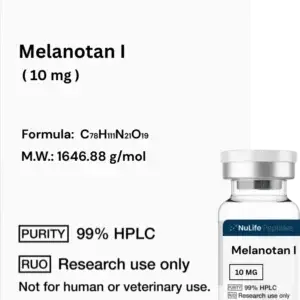
For Research Purposes Only — 99%+ Purity Guaranteed — USA Sourced
99%+ Purity
USA Made
Fast Ship

Melanotan I 10mg

$70.00

In stock

For Research Use Only

This product is intended for laboratory research purposes only. Not for human consumption, veterinary, or medical use.

Description
Overview

Melanotan I (MT-I) is a synthetic linear analog of α-melanocyte-stimulating hormone (α-MSH). In research settings, it is valued for its high selectivity toward the melanocortin-1 receptor (MC1R) and minimal central nervous system activity, making it a preferred tool for cutaneous, pigmentation, photobiology, and immune-signaling studies.

Biochemical Characteristics

Sequence: Ac-Ser-Tyr-Ser-Met-Glu-His-Phe-Arg-Trp-Gly-Lys-Pro-Val-NH₂
Molecular Formula: C₇₈H₁₁₁N₂₁O₁₉
Molecular Weight: 1646.8 g/mol
PubChem CID: 16197727

Research Applications

1. Melanogenesis & Pigmentation Research

Primary application

MT-I is widely used to:

  • Selectively activate MC1R on melanocytes

  • Elevate intracellular cAMP

  • Induce MITF expression

  • Increase melanogenic enzyme transcription (TYR, TYRP-1, TYRP-2)

Research uses include:

  • Controlled melanin synthesis assays

  • Eumelanin vs pheomelanin pathway studies

  • Benchmarking melanocyte responsiveness to MC1R agonism

Because of its predictability, MT-I often serves as a reference α-MSH analog in pigmentation experiments.


2. Photobiology & UV-Response Models

In preclinical skin models, Melanotan I is applied to study:

  • UV-induced cellular stress pathways

  • Melanin-mediated photoprotection mechanisms

  • Oxidative stress and reactive oxygen species (ROS) modulation

By favoring eumelanin production, MT-I enables researchers to explore how pigment type influences UV absorption and cellular resilience.


3. MC1R-Selective Receptor Pharmacology

MT-I’s receptor selectivity makes it especially useful in:

  • MC1R-specific signaling studies

  • Receptor–ligand binding assays

  • Structure–activity relationship (SAR) research

Receptor Research Activity
MC1R Strong, selective activation
MC3R Minimal
MC4R Minimal
MC5R Limited

This profile allows researchers to isolate peripheral melanocortin signaling without confounding CNS effects.


4. Immunomodulation & Inflammatory Signaling

MC1R is expressed on several immune and skin-resident cells, including:

  • Macrophages

  • Dendritic cells

  • Keratinocytes

In vitro and preclinical studies use MT-I to examine:

  • Cytokine expression modulation

  • Anti-inflammatory signaling pathways

  • Interaction with NF-κB, MAPK, and CREB signaling cascades

These studies focus on mechanistic immune regulation, not therapeutic outcomes.


5. Skin Biology & Barrier Function Research

Melanotan I has been utilized in experimental systems to explore:

  • Melanocyte–keratinocyte signaling

  • Pigment transfer mechanisms

  • Cellular differentiation and survival pathways in skin tissue models

Its MC1R specificity makes it well-suited for localized skin signaling investigations.


6. Peptide Design & Stability Comparisons

As a linear α-MSH analog, MT-I is frequently used as a comparator in:

  • Linear vs cyclic peptide stability studies

  • Proteolytic degradation assays

  • Peptide half-life and receptor residence time evaluations

These comparisons are foundational in peptide engineering and drug-design research.


Key Research Attributes

  • ✔ High MC1R selectivity

  • ✔ Minimal CNS melanocortin engagement

  • ✔ Predictable melanogenesis signaling

  • ✔ Widely cited in pigmentation and photobiology literature

  • ✔ Useful control compound in melanocortin research

Pathway / Mechanistic Context

1. Ligand–Receptor Interaction

Melanotan I (MT-I) is a synthetic linear analog of α-melanocyte-stimulating hormone (α-MSH).
In preclinical systems, it acts as a high-selectivity agonist of the melanocortin-1 receptor (MC1R), a Gs-coupled GPCR expressed predominantly on melanocytes and certain immune cells.

  • Primary receptor: MC1R

  • Minimal activation of: MC3R, MC4R, MC5R

This receptor selectivity defines MT-I’s localized, skin-focused signaling profile.


2. Primary Signal Transduction: Gs → cAMP

Upon MT-I binding to MC1R:

  1. Gs protein activation

  2. Stimulation of adenylyl cyclase

  3. Elevation of intracellular cAMP

  4. Activation of protein kinase A (PKA)

This Gs–cAMP–PKA axis is the dominant mechanistic pathway triggered by Melanotan I.


3. Nuclear Transcriptional Activation

Activated PKA phosphorylates CREB (cAMP response element-binding protein), which:

  • Increases transcription of MITF (microphthalmia-associated transcription factor)

  • MITF functions as the master transcriptional regulator of melanocyte biology

MITF upregulates expression of melanogenic enzymes:

  • Tyrosinase (TYR)

  • TYRP-1

  • TYRP-2

Functional outcome: increased melanogenesis with a bias toward eumelanin synthesis.


4. Melanin Type Modulation

MC1R activation by Melanotan I shifts melanocyte activity:

  • Away from pheomelanin (red/yellow pigments)

  • Toward eumelanin (brown/black pigments)

Eumelanin has greater:

  • UV-absorbing capacity

  • Free-radical scavenging ability

This mechanistic shift is a core focus in photobiology and oxidative stress research.


5. Secondary Signaling & Crosstalk

In addition to canonical cAMP signaling, MC1R activation by MT-I has been shown in preclinical models to influence:

  • MAPK / ERK pathways (cell survival, differentiation)

  • PI3K–Akt signaling (stress response modulation)

  • NF-κB inhibition (anti-inflammatory signaling)

These effects are context-dependent and vary by cell type and experimental conditions.


6. Immune & Anti-Inflammatory Signaling

MC1R is also expressed on:

  • Macrophages

  • Dendritic cells

  • Keratinocytes

MT-I–mediated MC1R activation in immune cells has been associated with:

  • Reduced pro-inflammatory cytokine expression

  • Enhanced anti-inflammatory signaling

  • Modulation of innate immune responses

This has made MT-I useful in in-vitro inflammation and immunomodulation studies.


7. Limited Central Nervous System Engagement

Due to:

  • Linear peptide structure

  • Lower lipophilicity

  • Reduced blood–brain barrier penetration

Melanotan I exhibits minimal CNS melanocortin signaling in preclinical research, in contrast to Melanotan II.

This mechanistic distinction:

  • Limits MC3R/MC4R activation

  • Reduces confounding neuroendocrine effects

  • Supports its use in peripheral-only signaling models


Mechanistic Summary (Signal Flow)

Melanotan I → MC1R binding → Gs activation → ↑ cAMP → PKA activation → CREB phosphorylation → ↑ MITF → ↑ melanogenic enzyme transcription → enhanced eumelanin production

Preclinical Research Summary

1. Pigmentation & Melanogenesis Research

Melanotan I has been extensively studied in in-vitro melanocyte cultures and animal models for its role in regulating melanin synthesis.

Mechanistic findings include:

  • Selective activation of MC1R

  • Increased intracellular cAMP

  • Activation of PKA → CREB

  • Upregulation of MITF

  • Increased transcription of melanogenic enzymes:

    • Tyrosinase (TYR)

    • TYRP-1

    • TYRP-2

Research applications:

  • Controlled melanogenesis modeling

  • Eumelanin vs pheomelanin ratio studies

  • Baseline melanocortin signaling assays

Melanotan I is frequently used as a reference α-MSH analog in pigmentation research due to its predictable and localized signaling profile.


2. Melanocortin Receptor Selectivity & Pharmacology

Unlike Melanotan II, Melanotan I demonstrates high selectivity for MC1R with minimal activity at MC3R and MC4R.

Receptor Research Relevance
MC1R Primary target (pigmentation, UV response)
MC3R Minimal activation
MC4R Minimal activation
MC5R Limited peripheral signaling

This selectivity makes MT-I valuable in:

  • Receptor-specific signaling studies

  • Isolation of cutaneous melanocortin pathways

  • Avoiding CNS confounding effects in experimental models


3. UV Response & Photobiology Studies

Preclinical studies have used Melanotan I to examine:

  • Melanin-mediated UV absorption

  • Cellular oxidative stress responses

  • DNA damage signaling following UV exposure

By increasing eumelanin production, MT-I has been shown in experimental systems to:

  • Improve melanocyte resistance to UV-induced stress

  • Reduce reactive oxygen species generation in cell models

These studies focus on cellular protection mechanisms, not clinical outcomes.


4. Inflammatory & Immunomodulatory Pathways

As an α-MSH analog, Melanotan I has been evaluated for:

  • Anti-inflammatory signaling via MC1R

  • Modulation of cytokine expression

  • Interaction with NF-κB, MAPK, and CREB pathways

Most research occurs in:

  • Cell culture models

  • Preclinical inflammation paradigms

MT-I is often chosen when researchers want to study immune signaling effects of MC1R activation without central melanocortin involvement.


5. Neuroendocrine & CNS Activity (Limited)

Due to:

  • Its linear structure

  • Reduced blood–brain barrier penetration

  • High MC1R selectivity

Melanotan I exhibits minimal central melanocortin activity in preclinical studies.
This contrasts with Melanotan II and is a key reason MT-I is preferred in skin-focused research models.


6. Peptide Design & Structure–Function Research

Melanotan I is commonly used as a comparator peptide in:

  • Linear vs cyclic peptide studies

  • Proteolytic stability experiments

  • Structure–activity relationship (SAR) analyses

Structural characteristics:

  • Linear α-MSH analog

  • Shorter half-life than cyclic MT-II

  • Lower receptor promiscuity

These features help researchers evaluate how cyclization and sequence modification alter receptor engagement and peptide stability.

Referenced Citations

No data was found
ALL ARTICLES AND PRODUCT INFORMATION PROVIDED ON THIS WEBSITE ARE FOR INFORMATIONAL AND EDUCATIONAL PURPOSES ONLY.
The products offered on this website are furnished for in-vitro studies only. In-vitro studies (Latin: in glass) are performed outside of the body. These products are not medicines or drugs and have not been approved by the FDA to prevent, treat or cure any medical condition, ailment or disease. Bodily introduction of any kind into humans or animals is strictly forbidden by law.
Product Index ×

Peptide Blends

Purchase Peptides

AOD 9604 5mg
BPC-157 10mg
DSIP 5mg
GHK-Cu 100mg
GHK-Cu 50mg
GHRP-2 10mg
GHRP-6 5mg
Ipamorelin
KPV 10mg
MOTS-c 10mg
NAD+ 500mg
Oxytocin 2mg
PT-141 10mg
Selank 10mg
Semax 30 mg
Product Index ×
×

Notify Me

We will email you when this item is back in stock.

Melanotan I 10mg
$70.00