For Research Purposes Only — 99%+ Purity Guaranteed — USA Sourced
99%+ Purity
USA Made
Fast Ship

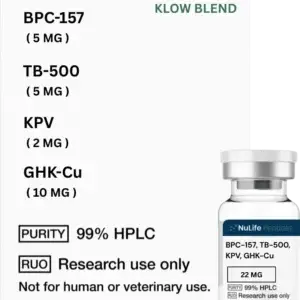
BPC-157, TB-500, KPV, GHK-Cu 22mg (Klow Blend)

$225.00

In stock

For Research Use Only

This product is intended for laboratory research purposes only. Not for human consumption, veterinary, or medical use.

Description
Overview of KLOW

The KLOW Blend combines peptides studied for cell signaling, tissue biology, immune modulation, and extracellular matrix dynamics. In research settings, this blend is used to explore multi-pathway interactions involving cytoprotection, actin dynamics, inflammatory signaling, and copper-dependent enzymatic processes.

What is KLOW?

1. BPC-157

Biological Origin:
Derived from a naturally occurring gastric peptide fragment (Body Protection Compound).

Primary Research Focus:

  • Cellular stress response

  • Angiogenesis signaling

  • Nitric oxide (NO) pathway modulation

  • Cytoskeletal and focal adhesion signaling

Mechanistic Highlights (Preclinical):

  • Interacts with FAK–paxillin and VEGF-related pathways

  • Modulates NO synthase activity

  • Demonstrates cytoprotective effects in cell and animal models

Why studied:
Used extensively in tissue integrity, wound-healing models, and gastrointestinal biology research.


2. TB-500

Biological Origin:
Synthetic analog of Thymosin Beta-4, a naturally occurring actin-binding peptide.

Primary Research Focus:

  • Actin cytoskeleton dynamics

  • Cell migration and differentiation

  • Angiogenesis and tissue remodeling

Mechanistic Highlights:

  • Binds G-actin, regulating actin polymerization

  • Influences cell motility and structural organization

  • Studied in cardiac, muscular, and connective tissue models

Why studied:
Serves as a model peptide for investigating cytoskeletal regulation and regenerative signaling.


3. KPV

Biological Origin:
C-terminal tripeptide of α-melanocyte-stimulating hormone (α-MSH).

Primary Research Focus:

  • Inflammatory signaling regulation

  • Immune cell modulation

  • Barrier function research

Mechanistic Highlights:

  • Modulates NF-κB signaling

  • Influences cytokine expression profiles

  • Acts via melanocortin-related immune pathways, largely independent of pigmentation

Why studied:
Favored in gut, skin, and immune research models due to its small size and signaling specificity.


4. GHK-Cu

Biological Origin:
Naturally occurring human plasma tripeptide (Gly-His-Lys) complexed with copper(II).

Primary Research Focus:

  • Gene expression modulation

  • Extracellular matrix (ECM) remodeling

  • Collagen and elastin synthesis pathways

Mechanistic Highlights:

  • Acts as a copper delivery system to cells

  • Influences MMP/TIMP balance

  • Regulates genes involved in wound repair and skin biology

Why studied:
Widely used in dermal biology, anti-aging research, and tissue remodeling studies.


Integrated Research Rationale (Why Combine Them)

In preclinical research, combining these peptides allows investigators to explore:

  • Cytoprotection + structural repair (BPC-157 + TB-500)

  • Inflammation control (KPV)

  • ECM and gene regulation (GHK-Cu)

  • Multi-pathway signaling synergy in tissue models

This makes the KLOW Blend attractive for systems-level research into tissue resilience, repair signaling, and inflammatory balance.

Research Applications

1. Tissue Integrity & Cytoprotection Models

Primary application

  • Studied in cell survival and stress-response assays

  • Explores how peptides influence:

    • Cellular resilience under mechanical, oxidative, or inflammatory stress

    • Barrier integrity in epithelial and endothelial models

Key contributors

  • BPC-157: cytoprotective signaling, angiogenic pathway modulation

  • TB-500: cytoskeletal stability and cell motility support


2. Cell Migration, Adhesion & Cytoskeleton Research

KLOW is applied in models examining:

  • Actin dynamics

  • Cell migration and spreading

  • Focal adhesion signaling

Mechanistic focus

  • TB-500: G-actin binding, actin polymerization control

  • BPC-157: FAK–paxillin and integrin-associated signaling

Used in scratch assays, 3D culture systems, and scaffold-based tissue models.


3. Inflammatory & Immune Signaling Studies

Researchers use KLOW to examine inflammation-regulating pathways:

  • Cytokine expression profiling

  • NF-κB and MAPK pathway modulation

  • Innate immune signaling balance

Key contributor

  • KPV: α-MSH–derived tripeptide studied for anti-inflammatory signaling independent of pigmentation pathways

Common in gut, skin, and immune-cell culture systems.


4. Extracellular Matrix (ECM) & Remodeling Research

KLOW is applied to investigate:

  • Collagen and elastin regulation

  • Matrix metalloproteinase (MMP) vs TIMP balance

  • Fibroblast signaling and ECM turnover

Key contributor

  • GHK-Cu: copper-dependent gene regulation and ECM signaling

Widely used in dermal biology, connective tissue, and wound-healing research models.


5. Angiogenesis & Vascular Signaling Models

In preclinical systems, KLOW components are studied for their influence on:

  • Endothelial cell signaling

  • VEGF-associated pathways

  • Microvascular organization in tissue constructs

This application is mechanistic, focusing on signal integration, not outcomes.


6. Systems-Level / Multi-Pathway Research

Because KLOW combines peptides with distinct but complementary signaling roles, it is used to explore:

  • Crosstalk between cytoprotection, inflammation, and remodeling pathways

  • Sequential signaling events in complex tissue models

  • Synergistic vs isolated peptide effects

Often applied in organoid models, co-culture systems, and advanced in-vitro platforms.

Why Researchers Study KLOW

  • Enables multi-signal pathway interrogation

  • Useful in complex tissue and repair models

  • Combines structural, immune, and ECM biology

  • Supports systems-biology approaches to peptide signaling

Preclinical Research Summary of KLOW

1. Tissue Integrity & Cytoprotection

Preclinical studies employ KLOW to examine:

  • Cell survival under stress (oxidative, inflammatory, mechanical)

  • Barrier integrity in epithelial/endothelial models

Mechanistic contributors

  • BPC-157: cytoprotective signaling; modulation of NO and VEGF-associated pathways

  • TB-500: actin dynamics supporting cellular structure and resilience


2. Cell Migration, Adhesion & Cytoskeletal Dynamics

KLOW is applied in assays investigating:

  • Actin polymerization and G-actin sequestration

  • Cell migration and focal adhesion signaling

  • Wound-gap (scratch) and 3D scaffold models

Key roles

  • TB-500: direct actin binding influencing motility

  • BPC-157: FAK–paxillin and integrin-linked signaling


3. Inflammatory & Immune Signaling

In vitro and animal models use KLOW to probe:

  • Cytokine expression profiles

  • NF-κB and MAPK pathway modulation

  • Innate immune signaling balance

Primary driver

  • KPV: α-MSH–derived tripeptide studied for anti-inflammatory signaling independent of pigmentation pathways


4. Extracellular Matrix (ECM) Remodeling

KLOW supports investigations into:

  • Collagen and elastin synthesis

  • MMP/TIMP balance

  • Fibroblast signaling and matrix turnover

Primary driver

  • GHK-Cu: copper-dependent gene regulation and ECM remodeling pathways


5. Angiogenesis & Vascular Biology

Preclinical research applies KLOW to explore:

  • Endothelial cell signaling

  • Microvascular organization

  • VEGF-associated angiogenic pathways

These studies are mechanistic, focusing on signaling integration rather than outcomes.


6. Systems-Biology & Multi-Pathway Modeling

Because KLOW combines peptides with distinct but complementary mechanisms, it is used to:

  • Study pathway crosstalk between cytoprotection, inflammation, and remodeling

  • Compare single-peptide vs combination effects

  • Evaluate temporal signaling sequences in complex tissue models (co-cultures, organoids)

Referenced Citations

No data was found
ALL ARTICLES AND PRODUCT INFORMATION PROVIDED ON THIS WEBSITE ARE FOR INFORMATIONAL AND EDUCATIONAL PURPOSES ONLY.
The products offered on this website are furnished for in-vitro studies only. In-vitro studies (Latin: in glass) are performed outside of the body. These products are not medicines or drugs and have not been approved by the FDA to prevent, treat or cure any medical condition, ailment or disease. Bodily introduction of any kind into humans or animals is strictly forbidden by law.
Product Index ×

Peptide Blends

Purchase Peptides

AOD 9604 5mg
BPC-157 10mg
DSIP 5mg
GHK-Cu 100mg
GHK-Cu 50mg
GHRP-2 10mg
GHRP-6 5mg
Ipamorelin
KPV 10mg
MOTS-c 10mg
NAD+ 500mg
Oxytocin 2mg
PT-141 10mg
Selank 10mg
Semax 30 mg
Product Index ×
×

Notify Me

We will email you when this item is back in stock.

BPC-157, TB-500, KPV, GHK-Cu 22mg (Klow Blend)
$225.00